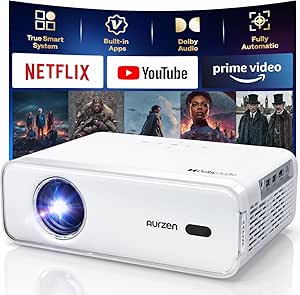
For most outdoor movie nights, I’d start with the ONOAYO Outdoor 4K Projector: its auto focus and built-in apps favor quick setup, while the HAPPRUN Outdoor Smart 4K and Aurzen Roku TV D1R stand out for built-in entertainment and familiar streaming access. The main tradeoff is between a projector that’s easy to set up and stream from, one that’s simpler to carry, and one that can produce a more watchable image as daylight fades. Native 1080p models can be a sensible choice when you value clear everyday viewing over a 4K-support label. I compare all 15 options by outdoor usability, setup, sound, and portability below. Read on for the full breakdown and guidance on choosing for your space.

Get your wardrobe favorites delivered free with Prime
- Fast, free delivery on millions of items
- Prime Video, Amazon Music and more included
- Member-only deals all year
Key Takeaways
- The ONOAYO’s auto focus and built-in apps make it a strong all-round fit for buyers who want less setup friction; those features matter more outdoors when you may be positioning the projector on uneven ground.
- Roku-equipped Aurzen and HAPPRUN models emphasize familiar streaming, while other built-in-app models can vary in interface and service support; check the exact app access you need before buying.
- Native 1080p is a clearer baseline than a vague 4K-support claim: several picks advertise 4K support while identifying their native resolution as 1080p.
- Auto focus, adjustable stands, and compact designs address different hassles: focus helps with setup, a stand helps with placement, and smaller bodies help with carrying.
- Outdoor viewing still depends heavily on darkness and power access; none of the listed feature sets removes the need to plan for a dim viewing area, a stable surface, and suitable power.




More Details on Our Top Picks
HAPPRUN Outdoor Smart 4K Projector with Built-in Apps and Dolby Audio
For backyard viewing where the screen may be larger and ambient light harder to control, I’d rank the HAPPRUN ahead of the Aurzen Roku TV E1R: its stated 1500 ANSI lumens give it a clearer brightness advantage over that model’s 160 lumens. Built-in streaming apps, Wi-Fi 6, and auto-focus with smart screen adjustment also reduce the gear and setup steps needed before a movie. Its 4K decoding and 2 x 15W speakers add flexibility, though decoding 4K is not the same as a stated native 4K resolution. The tradeoff is that the product data gives no battery-life or power-source details, so I’d plan on access to power rather than assume it suits remote camping. The sound may also call for external speakers if you want fuller outdoor audio.
Pros:- Stated 1500 ANSI lumens provide a brightness advantage over the 160-lumen Aurzen Roku TV E1R.
- Built-in streaming apps reduce reliance on a separate streaming device.
- Auto-focus and smart screen adjustment can shorten setup time outdoors.
- Offers ceiling, table, tripod, and wall mounting options.
Cons:- Battery life and power-source details are not provided, limiting confidence for remote use.
- 4K decoding does not specify native 4K resolution.
- Built-in audio may not satisfy buyers seeking stronger outdoor sound without external speakers.
Best for: Backyard movie hosts with access to an outlet who want built-in streaming, quick image setup, and more stated brightness than the compact Aurzen Roku TV E1R.
Not ideal for: Campers who need a projector with confirmed battery operation, or buyers who require a specified native 4K resolution and detailed power information.
Our verdict“Choose the HAPPRUN for a powered backyard setup where its stated brightness and built-in apps matter more than battery details or verified native 4K.”
Aurzen Roku TV E1R Smart Portable Mini Projector with WiFi and Bluetooth
The E1R is the easiest option here to carry casually: at under 1 lb, it is much lighter than the 2.1 kg Aurzen Roku TV D1R. Its built-in Roku OS gives buyers familiar streaming access without needing to connect a separate stick, and the 180° adjustable stand helps when a wall or screen sits above or beside the projector. Those conveniences suit a small, dark room or a close-up campsite setup, but the 160-lumen brightness is a serious limit for outdoor viewing once dusk has not fully settled. Its 720p resolution also falls short of the D1R’s native 1080p, and the maximum throw distance of 9.6 feet constrains placement. I’d choose it for portability and simple streaming, not for a large, bright backyard image.
Pros:- Under-one-pound weight makes it the easiest model in this group to carry.
- Built-in Roku OS provides streaming without a separate stick.
- 180° adjustable stand allows flexible projection angles.
- Wi-Fi, Bluetooth, HDMI, and USB support multiple source options.
Cons:- 160 lumens restrict outdoor viewing to very dark conditions.
- 720p resolution is lower than the Aurzen Roku TV D1R’s native 1080p.
- Maximum throw distance of 9.6 feet limits placement and image size.
Best for: Travelers and casual campers who prioritize a sub-one-pound projector with built-in Roku streaming for viewing in dark, compact spaces.
Not ideal for: Backyard hosts seeking a large, bright outdoor image or buyers who want native 1080p resolution and flexible long-distance placement.
Our verdict“Pick the E1R if low weight and Roku convenience matter more than brightness, resolution, or a large outdoor projection.”
ONOAYO Outdoor 4K Projector with AI Auto Focus, Dolby Audio, Built-in Apps
At 2.4 lb, the ONOAYO combines a light carry with built-in apps, AI auto-focus, and a stated 50W speaker system. That makes it a more feature-packed portable choice than the basic HAPPRUN Native 1080P Bluetooth Projector, which requires a TV stick for streaming and lists built-in speakers without a power rating. The ONOAYO also supports Wi-Fi 6, Bluetooth, Chromecast, and several mounting styles, giving it useful flexibility between a patio and indoor rooms. Its main outdoor uncertainty is brightness: no lumen figure is supplied, so I can’t confidently rank its daylight or twilight performance against the HAPPRUN Outdoor Smart model’s 1500 ANSI lumens. The listing also says 4K without clarifying native resolution. I’d favor it for portability and convenience in dark settings, not for buyers who need measurable brightness specifications.
Pros:- 2.4 lb weight is practical for moving between indoor and outdoor setups.
- Built-in apps and Chromecast reduce dependence on external playback devices.
- AI auto-focus can simplify setup on changing surfaces.
- Lists 50W speakers and Dolby Audio for an all-in-one sound option.
Cons:- Brightness is described without a lumen figure, making outdoor performance hard to compare.
- The 4K specification does not clarify native resolution.
- Details about the sealed optical engine and cooling system are limited.
Best for: Frequent movers who want a lightweight projector with built-in apps, automatic focusing, and a strong stated speaker rating for dark outdoor viewing.
Not ideal for: Buyers planning to watch before full darkness or those who need confirmed ANSI brightness and clearly specified native resolution.
Our verdict“Choose the ONOAYO for a light, app-ready projector in dark settings, but choose the HAPPRUN Outdoor Smart model if a stated brightness figure is your priority.”
Aurzen Roku TV D1R Smart Portable Outdoor Projector with WiFi and Bluetooth
The D1R is the more balanced pick for buyers who want streaming and clear detail without relying on 4K decoding claims: it specifies native 1920 x 1080 resolution and has Roku built in. Compared with the lighter Aurzen Roku TV E1R, it gives up extreme portability but offers a larger placement range, from a 3.71-foot minimum throw to a maximum of 18.58 feet, and supports images from 40 to 200 inches. Auto-focus and keystone correction can cut down on manual alignment outside. Its 2.1 kg weight is less appealing for frequent carrying, and the product information does not provide a brightness figure, so I would reserve it for properly darkened outdoor viewing rather than assume it will handle twilight. Fan noise may also stand out during quiet scenes.
Pros:- Native 1920 x 1080 resolution provides specified Full HD detail.
- Built-in Roku supports streaming without a separate stick.
- 40–200-inch image range and broad throw-distance range allow flexible placement.
- Auto-focus and keystone correction can simplify outdoor alignment.
Cons:- At 2.1 kg, it is heavier than the Aurzen Roku TV E1R.
- Brightness is not specified, leaving outdoor performance difficult to judge.
- Fan noise may be noticeable during quieter content.
Best for: Backyard movie viewers who want native 1080p, built-in Roku, and flexible placement for a larger screen after dark.
Not ideal for: Hikers and campers who prioritize a sub-one-pound carry, or outdoor viewers who need a documented brightness level for twilight use.
Our verdict“Choose the D1R for Roku and specified native 1080p in a fixed backyard setup, but skip it if low weight or documented brightness is essential.”
HAPPRUN Native 1080P Bluetooth Projector
This HAPPRUN makes the most sense for buyers who already have a streaming stick, laptop, or console: its native 1920 x 1080 resolution and HDMI, USB, and Bluetooth connections support a straightforward mix of sources. Unlike the Aurzen Roku TV D1R, it does not include Roku, so streaming requires an added device; in exchange, its source setup is less tied to a built-in platform. The listed 200-inch maximum image size offers room for a broad backyard screen, but a large image also needs a dark environment, and no brightness figure is given here to help estimate twilight performance. It weighs less than the D1R, though the data does not state an exact weight. I’d treat it as a flexible, powered projector—not a self-contained camping unit.
Pros:- Native 1920 x 1080 resolution is clearly specified.
- HDMI, USB, Bluetooth, and 3.5 mm audio connections support varied equipment.
- Listed maximum image size of 200 inches suits large-screen setups.
- Compatible with phones, tablets, laptops, consoles, and external speakers.
Cons:- Requires a TV stick or another source device for streaming.
- Brightness is not specified, making twilight suitability difficult to judge.
- Bluetooth audio does not support video casting, limiting wireless playback options.
Best for: Backyard users who already own an HDMI streaming stick, laptop, or game console and want native 1080p with flexible wired connections.
Not ideal for: Buyers who want streaming apps built in, confirmed outdoor brightness, or a lightweight setup with clearly specified battery operation.
Our verdict“Pick this HAPPRUN if you have your own streaming or gaming device and want native 1080p, but choose the Aurzen Roku TV D1R for built-in streaming.”
4K Smart Projector with Google TV, WiFi, Bluetooth, Dolby Atmos, Portable Outdoor Movie Phone
For outdoor movie nights where streaming convenience matters more than battery-free portability, this model stands out for its Google TV interface and broad app access. Netflix, Disney+, Prime Video, and Hulu are listed among its supported platforms, so you can stream directly rather than depending on a separate stick or phone mirroring. Its 360° rotating body, auto focus, and auto keystone correction also help when a flat, level setup surface is hard to find. Compared with the Aurzen EAZZE D1, it adds Google TV and Chromecast support, while the Aurzen’s listed built-in apps keep its streaming setup simpler. The tradeoff is that this projector displays at native 1080p, despite supporting 4K input, and it needs an external power source. I’d choose it for a powered patio setup, not a remote campsite.
Pros:- Google TV provides access to listed streaming platforms without requiring a separate streaming device.
- Auto focus and auto keystone correction can reduce setup adjustments on uneven outdoor surfaces.
- 360° rotating body allows flexible projection direction.
- Dolby Atmos support and Bluetooth 5.2 offer sound options beyond the built-in setup.
Cons:- Native display resolution is 1080p, not 4K.
- Requires an external power source, limiting use away from outlets or a generator.
- The number of smart features may add setup complexity for buyers who want a simple projector.
Best for: Outdoor movie hosts with access to mains power who want familiar streaming apps and automatic image adjustment in one projector.
Not ideal for: Campers seeking a battery-powered projector or buyers who expect native 4K image output.
- Resolution:Native 1080p; supports 4K input
- HDR:HDR10+
- Color coverage:98% NTSC
- Audio:Dolby Atmos; Bluetooth 5.2
- Connectivity:WiFi 6, HDMI, USB, audio ports, AirPlay, Miracast, Chromecast
- Smart platforms:Google TV; Netflix, Disney+, Prime Video, Hulu, Google Play Store
- Adjustment features:Auto focus, auto keystone, digital zoom, screen fit
- Portability and cooling:360° rotating body; dual-fan cooling rated at 30 dB
Our verdict“Choose this for a powered outdoor setup where built-in Google TV matters more than native 4K or battery operation.”
Native 1080P Portable Mini Projector with 4K Support, WiFi 6, Bluetooth 5.2, Dolby Audio, Auto Focus, 360° Adjustable Stand, HDR10
The iWIMIUS S29 is a strong fit for outdoor setups that need a projector to point in several directions without a complicated mount. Its built-in 360° stand and auto focus make it easier to aim at a screen or blank wall, while native 1080p gives it a clear resolution advantage over the Mini Projector with Wi‑Fi and Bluetooth, Built-in Apps, which is limited to native 720p. The 1.1:1 throw ratio can also help when there isn’t much distance between the projector and screen. Two 10W speakers reduce the need to pack separate audio for a small gathering. The main outdoor caveat is brightness: the listing gives no lumen figure, so I can’t judge how well it will hold up as evening light fades. Some apps may also be limited to browser access, making it less straightforward than a dedicated smart TV interface.
Pros:- Native 1080p resolution offers a sharper baseline than the native 720p Mini Projector with Wi‑Fi and Bluetooth, Built-in Apps.
- 360° adjustable stand makes aiming easier on patios and other uneven setups.
- Dual 10W Dolby Audio speakers provide substantial onboard sound for casual viewing.
- Auto focus and 4D/4P auto vertical keystone correction help simplify image setup.
Cons:- Brightness is not specified, leaving outdoor visibility difficult to judge.
- Some apps may only be accessible through a web browser.
- Remote requires two AAA batteries that are not included.
Best for: Outdoor movie viewers who want native 1080p, onboard speakers, and an adjustable stand for quick placement on a table or tripod.
Not ideal for: Buyers who need documented brightness for dusk viewing or want a clearly specified set of built-in streaming apps.
- Resolution:Native 1080p; 4K support
- HDR:HDR10
- Contrast ratio:20,000:1
- Projection size:50–200 inches
- Throw ratio:1.1:1
- Weight and dimensions:2.4 lb; 4.5 × 4.8 × 9.4 inches
- Audio:Dual 10W Dolby Audio speakers
- Connectivity:WiFi 6, Bluetooth 5.2, HDMI, USB, 3.5 mm audio jack
- Setup and mounting:360° built-in stand; auto focus; 4D/4P auto vertical keystone; tripod, wall, and ceiling support
Our verdict“Pick the S29 if adjustable placement and native 1080p matter more than a published brightness rating or seamless app access.”
Aurzen EAZZE D1 Smart Portable Outdoor Projector with WiFi and Bluetooth
The EAZZE D1 suits buyers who want a 1080p smart projector with automatic framing help, without relying on a separate streaming device for its listed services. Netflix, Prime Video, and YouTube are built in, and auto focus, keystone correction, obstacle avoidance, and screen alignment can help get a picture in place when the projector is moved between indoor and outdoor spots. Compared with the 4K Smart Projector with Google TV, the EAZZE’s app setup is more limited: its app selection is pre-installed and cannot be expanded. That constraint may be a fair trade for someone who mainly watches the included services, but less so for households with specific apps. It also needs a power source, and casting restrictions can interrupt streaming from some services, so I’d keep a compatible HDMI source as a backup for outdoor gatherings.
Pros:- Native 1080p resolution and HDR10 support suit movie viewing in a dark outdoor setting.
- Built-in Netflix, Prime Video, and YouTube reduce dependence on a separate streaming stick.
- Auto focus, keystone correction, obstacle avoidance, and screen alignment assist with placement.
- HDMI, two USB ports, and a headphone jack allow several wired source and audio options.
Cons:- Built-in apps cannot be expanded beyond the pre-installed selection.
- Casting restrictions may block content from some streaming services.
- Bluetooth transmits audio only, not video.
Best for: Viewers who mainly use Netflix, Prime Video, or YouTube and want automatic image setup for occasional patio movie nights.
Not ideal for: Households that rely on apps outside the pre-installed selection or expect every streaming service to work through phone casting.
- Resolution:Native 1080p
- HDR:HDR10
- Speakers:2 × 8W digital speakers
- Wireless connectivity:Dual-band 5G/2.4G WiFi; Bluetooth 5.1
- Ports:HD port, two USB ports, 3.5 mm headphone jack
- Built-in apps:Netflix, Prime Video, YouTube, App Store
- Automatic setup:Auto focus, auto keystone correction, auto obstacle avoidance, auto screen alignment
- Zoom:50% to 100%
- Mounting options:Ceiling, tabletop, tripod, and wall mount
Our verdict“Choose the EAZZE D1 for simple access to its included apps and automatic setup, but skip it if you need a wider app library or dependable casting.”
White Smart Mini Projector with WiFi and Bluetooth, 4K Support, Native 1080P, Portable Outdoor Projector with Auto Focus and 360° Stand
At 1.89 lb, this XuanPad is the portability-focused option for people carrying gear to a backyard, campsite with power, or a friend’s patio. It pairs native 1080p resolution with auto focus, 6D keystone correction, and a 360° rotatable stand, so setting a usable picture can be easier than with a basic projector that needs repeated manual adjustments. Compared with the iWIMIUS S29, it is lighter and thinner, while the iWIMIUS lists its speaker wattage and short-throw ratio more clearly. XuanPad’s data does not specify brightness or battery life, which matters outdoors: lighter to carry does not mean it can run without power or remain clear before dark. I’d favor it for compact transport and flexible aiming, not for daytime viewing or buyers planning a long trip away from outlets.
Pros:- At 1.89 lb, it is lighter than the 2.4 lb iWIMIUS S29.
- Native 1080p resolution supports clear viewing compared with native 720p alternatives.
- Auto focus and 6D keystone correction reduce manual setup work.
- A 360° rotatable stand gives flexibility when the screen is not straight ahead.
Cons:- Battery life is not specified, and the data does not establish battery-powered operation.
- Brightness is not provided, making outdoor performance in ambient light uncertain.
- The built-in speaker is listed without power or audio-format details.
Best for: Travelers and backyard hosts who prioritize a lightweight 1080p projector with automatic image correction and flexible aiming.
Not ideal for: Campers without access to power or anyone who needs a stated brightness level for viewing before full darkness.
- Native resolution:1920 × 1080
- Maximum resolution:3840 × 2160 pixels
- Projection size:40–200 inches
- Weight and thickness:1.89 lb; 2.69 inches thick
- Connectivity:Wi-Fi 6, Bluetooth 5.2, HDMI, USB, 3.5 mm jack
- Image adjustment:Auto focus; 6D keystone correction
- Stand:360° rotatable
- Audio:Built-in speaker
Our verdict“Choose this XuanPad for lightweight carrying and easy aiming, provided you can supply power and plan to watch after dark.”
Mini Projector, Portable Projector with Wi‑Fi and Bluetooth, Built-in Apps
Weighing just 0.77 lb, this mini projector is the easiest pick here to slip into a bag for a casual outdoor screening. Its 0.9:1 throw ratio and 180° rotating design give it placement flexibility in tight spaces, and built-in apps such as YouTube and Prime Video reduce the need to pack another device. But its key tradeoff is picture detail: native resolution is 720p, unlike the native 1080p XuanPad or Aurzen EAZZE D1. The listed 500 lumens also point to dark-night use rather than dusk or a bright patio, and the product data does not state battery operation. Although it can play 4K video via USB, that does not change its native resolution. I’d choose it for low-bulk travel, not for buyers prioritizing image sharpness or outdoor brightness.
Pros:- At 0.77 lb, it is the lightest option in this batch.
- A 0.9:1 throw ratio can produce a large image from a relatively short distance.
- Built-in YouTube and Prime Video apps limit the need for extra streaming hardware.
- 180° rotation and auto keystone correction support flexible positioning.
Cons:- Native 720p resolution is lower than the native 1080p XuanPad and Aurzen EAZZE D1.
- 500 lumens are better suited to a dark setting than ambient outdoor light.
- Battery operation is not specified, so portable weight does not guarantee cord-free use.
Best for: Light packers who want a very small projector for dark outdoor movie nights and value built-in YouTube and Prime Video.
Not ideal for: Viewers who want native 1080p detail, plan to watch before dark, or need confirmed battery-powered operation.
- Weight and dimensions:0.77 lb; 3.73 × 3.73 × 6.17 inches
- Brightness:500 lm
- Native resolution:1280 × 720
- Maximum playback resolution:3840 × 2160 (4K playback)
- Contrast ratio:8000:1
- Throw ratio:0.9:1
- Screen size and distance:30–200 inches; recommended 40–100 inches; 0.8–10 ft throw distance
- Connectivity:2.4G/5G Wi-Fi, Bluetooth 5.2, HDMI
- Adjustment and audio:Auto keystone; auto and manual focus; 180° rotation; stereo speakers
Our verdict“Pick this model for the lightest possible kit and dark-night convenience, but choose a native 1080p projector for sharper outdoor viewing.”
Mini Projector with Wi-Fi and Bluetooth, Built-in Apps
For outdoor movie nights where the projector has to sit at an awkward angle, this model’s 210° rotation and electric focus offer more placement freedom than the fixed-position feel of the TMY Native 1080P Mini Portable Projector. Built-in apps and wireless phone connectivity also cut down on extra gear, though the streaming features rely on a Wi-Fi network; they are less useful at a campsite without internet. Its 300 ANSI lumens suit dark evenings, not a yard with lingering daylight, and the stated 4K compatibility does not change its native 1080P output. The stereo speakers can simplify a casual setup, but Bluetooth connects to audio devices rather than smartphones. I’d pick it for adaptable positioning and app access, not for bright-environment viewing.
Pros:- 210° adjustable rotation helps fit unusual outdoor placements
- Electric focus makes image sharpening easier after moving the projector
- Built-in streaming apps reduce the need for a separate streaming device
- Native 1080P resolution and stereo speakers support a simple movie setup
Cons:- 300 ANSI lumens are better suited to dark conditions than ambient light
- Wireless streaming features require a Wi-Fi network
- Bluetooth supports audio devices, not smartphone pairing
Best for: Outdoor movie hosts who need flexible ceiling, wall, or angled placement and can provide Wi-Fi after dark
Not ideal for: Campers without Wi-Fi or viewers who need a bright picture before full darkness
- Native resolution:1080P HD
- 4K support:Compatible
- Brightness:300 ANSI lumens
- Screen size:50–200 inches
- Wireless:Wi-Fi 6; Bluetooth 5.3
- Connections:HDMI, USB, audio
- Focus:Electric
- Rotation:210° adjustable
- Built-in apps:Prime Video, YouTube, Hulu, app store
Our verdict“Choose this for flexible positioning and built-in apps when your outdoor viewing area can be made properly dark and has Wi-Fi.”
Smart Outdoor Projector with WiFi, Bluetooth, Dual Speakers, Auto Focus and YouTube & Prime Video – P62 Pro
The P62 Pro has the strongest stated brightness in this group at 600 ANSI lumens, giving it an advantage over the 300-lumen Aurzen Roku TV D1R Air when the sky is not fully dark. That extra output can make a backyard image easier to see, though it does not make this a daylight projector. Auto focus and keystone correction reduce setup fiddling, while built-in apps and two HDMI ports make it practical for switching between streaming and a console or laptop. Its native resolution remains 1080P, so 4K support means compatible playback rather than a 4K image. The dual 10W speakers are more substantial than the smaller units in this lineup, but there is no carrying case, adding one more item to pack.
Pros:- 600 ANSI lumens offer more headroom than the 300-lumen Aurzen D1R Air
- Auto focus and auto keystone correction simplify setup on changing surfaces
- Two HDMI ports make it easier to leave multiple sources connected
- Dual 10W speakers provide more on-projector audio output
Cons:- Native resolution is 1080P, so 4K content is downscaled
- No carrying case is included
- The stated brightness still favors dusk or dark viewing over daylight
Best for: Backyard hosts who want more brightness than compact 300-lumen options and plan to connect multiple sources
Not ideal for: Travelers who need a case included or buyers expecting native 4K projection
- Native resolution:1080P
- 4K support:Supported; output is native 1080P
- Brightness:600 ANSI lumens
- HDR:HDR10
- Speakers:Dual 10W Hi-Fi with Dolby audio
- Wireless:Wi-Fi 6; Bluetooth 5.2
- HDMI:2 ports; HDMI 1 CEC, HDMI 2 ARC and CEC
- Setup:AI auto focus and auto keystone correction
- Zoom range:50–100%
Our verdict“Pick the P62 Pro if you want the brightest stated output here, built-in apps, and convenient source switching for backyard use.”
Aurzen Roku TV D1R Air USB-C Powered Smart Portable Outdoor Projector
The D1R Air is the clearest choice here for buyers who want a compact projector with Roku built in and a way to power it from a compatible USB-C PD source. At 2.6 pounds, it is easier to carry than the larger-feeling P62 Pro, and auto focus plus keystone correction help when there is no permanent outdoor screen position. Its 300 ANSI lumens point to night use: the smaller body does not overcome the need for a dark setting. Roku’s familiar app interface also means less dependence on phone mirroring, but outdoor use hinges on having a 65W-or-higher USB-C PD power source. I’d favor it for travel and quick streaming, while buyers with no suitable power bank should look at a mains-powered option instead.
Pros:- Built-in Roku TV provides direct access to streaming apps
- USB-C PD input allows use with compatible portable power sources
- At 2.60 pounds, it is relatively easy to carry
- Auto focus and keystone correction make temporary placement simpler
Cons:- Requires a 65W-or-higher USB-C PD power source for flexible outdoor power
- 300 ANSI lumens are best suited to dark viewing
- Fan noise is specified at 29–35 dB and may be noticeable in quiet scenes
Best for: Travelers and small-space movie watchers with a 65W-or-higher USB-C PD power source and a preference for Roku apps
Not ideal for: Campers who lack compatible USB-C PD power or anyone expecting a bright image at dusk
- Native resolution:1080P
- Brightness:300 ANSI lumens
- Power input:65W+ USB-C PD
- Dimensions:5.35 × 4.33 × 10.12 inches
- Weight:2.60 pounds
- Speakers:Dual 5W with Dolby Audio
- Wireless:2.4G/5G Wi-Fi; Bluetooth 5.2
- Connections:USB-C, HDMI, USB, audio out
- Fan noise:29–35 dB
Our verdict“Choose the D1R Air for compact Roku streaming away from an outlet if you already have compatible USB-C PD power.”
TMY Native 1080P Mini Portable Projector with 80-Inch Screen and Bluetooth
The TMY’s main outdoor advantage is not a smart interface or automatic setup; it is the included 80-inch foldable screen. That saves buyers from sourcing a blank wall or buying a screen separately, giving it a more self-contained starting point than the Mini Projector with Wi-Fi and Bluetooth, Built-in Apps. The tradeoff is a less connected experience: it offers HDMI, USB, and Bluetooth, but phone connections may require adapters, and Bluetooth carries audio rather than video. The listed native resolution is 1280 × 720, despite the product title’s 1080P wording and a stated 1920 × 1080 display resolution, so I would not choose it for buyers who prioritize clear native 1080P specs. Its bundled screen makes the most sense for simple, dark-yard viewing with a source device already in hand.
Pros:- Includes an 80-inch foldable screen for a more complete starter setup
- HDMI and USB support common external media sources
- Portable design suits occasional indoor and outdoor use
- Bluetooth can send audio to a compatible speaker
Cons:- Listed native resolution is 1280 × 720, despite 1080P wording elsewhere
- Phone adapters are not included and may be needed
- Bluetooth transmits audio, not video, and some streaming apps restrict mirroring
Best for: First-time outdoor movie hosts who want an included screen and already have an HDMI source or suitable phone adapter
Not ideal for: Buyers who require clearly specified native 1080P output or want direct wireless video streaming from a phone
- Native resolution:1280 × 720
- Display resolution:1920 × 1080
- Display type:LCD
- Projection size:32–220 inches
- Projection distance:1.5–6 m
- Contrast ratio:10000:1
- Lamp lifetime:10,000 hours
- Connections:HDMI, USB, Bluetooth, 3.5 mm jack
- Included screen:80-inch foldable
Our verdict“Pick the TMY if the included screen matters more to you than built-in apps or clearly documented native 1080P resolution.”
HAPPRUN Roku TV Smart Mini Projector with WiFi and Bluetooth
For buyers who want to start a show without connecting a separate streamer, this HAPPRUN pairs built-in Roku with a compact form and Dolby Audio. It has a useful stated image-size range up to 120 inches, though for outdoor viewing that larger image can be harder to enjoy unless the screen is distant and the setting is dark. Compared with the Aurzen Roku TV D1R Air, this model lists HDMI with ARC and dual-band Wi-Fi, but its resolution is only described as “maximum HD,” leaving less certainty about picture detail. The product data also does not specify power-bank support, so portability should not be mistaken for battery operation. I’d choose it for straightforward Roku access near an outlet, rather than for buyers building a lightweight, power-independent camping kit.
Pros:- Built-in Roku supports app-based streaming without a separate player
- HDMI with ARC and USB 2.0 provide practical wired connections
- Maximum image size is listed at 120 inches
- Dolby Audio and Bluetooth 5.2 offer flexible audio options
Cons:- Resolution is described only as maximum HD, without a specific native figure
- Brightness is not specified, making outdoor image performance harder to judge
- No battery or USB-C power support is listed
Best for: Roku users who want a compact projector for backyard or home viewing near a power source
Not ideal for: Campers seeking battery operation or buyers who need a clearly stated native resolution and brightness level
- Streaming platform:Built-in Roku
- Resolution:Maximum HD; exact resolution not specified
- Display type:LCD
- Maximum image size:120 inches
- Throw distance:3.28–17.43 feet
- Wireless:Dual-band Wi-Fi; Bluetooth 5.2
- Connections:HDMI with ARC, USB 2.0, 3.5 mm jack
- Audio:Dolby Audio
- Power:42 watts
Our verdict“Choose this HAPPRUN for convenient Roku streaming near an outlet, but skip it if you need verified resolution, brightness, or portable-power details.”

How We Picked
I ranked these portable projectors for outdoors by how well their listed features address a real outdoor setup: getting a usable picture in place, accessing content, hearing dialogue, and carrying or powering the unit. I gave weight to native resolution claims, auto focus, built-in streaming, audio features, connectivity, and included accessories, while treating 4K support as distinct from native 4K resolution. I also considered whether a product’s feature mix seems better suited to quick setup, flexible placement, or straightforward movie playback.
The ranking reflects how complete and clearly described each outdoor-use package appears, not a claim that one specification guarantees performance in every setting. Models with distinct practical advantages, such as Roku TV access, auto focus, a 360-degree stand, or an included screen, earned a clearer role. Where listings leave brightness, battery operation, weather resistance, or app support unclear, I treat that uncertainty as a buying drawback rather than filling in details. Check the current listing for those specifications before choosing.
Factors to Consider When Choosing Portable Projectors For Outdoors
Choosing a projector for outside involves more than picking the most impressive resolution label. I’d work backward from where you plan to watch, how you’ll power and position the unit, and whether you want a separate streaming device. These checks can prevent common mismatches that a feature list alone won’t reveal.
Match Brightness to the Time and Place
Outdoor projection is most forgiving after dusk, when stray light no longer washes out the image. A projector that looks adequate in a dark bedroom may seem weak beside patio lights or a bright wall. Compare brightness claims carefully, and look for a clearly stated measurement rather than relying on a broad claim such as “outdoor” or “4K.” If the listing does not state brightness in a way you can compare, treat daytime use as uncertain. A smaller image can look more watchable than stretching the picture across a large wall. For dependable outdoor viewing, plan around darkness instead of assuming a portable projector can overpower ambient light.
Read Resolution Claims Carefully
Native resolution describes the image the projector displays directly, while “supports 4K” can refer to the input signal it accepts. Those claims are not interchangeable, so check the native resolution before paying extra for a 4K-support label. For casual movie nights, native 1080p may be a more useful comparison point than headline compatibility. Resolution also has to be balanced against screen size and viewing distance: a very large image can make limitations more visible. Match the projector to the size of the space rather than assuming bigger is always better. This helps keep marketing language from setting expectations the listed display resolution does not support.
Plan Streaming Before You Set Up Outside
Built-in apps can reduce the number of devices and cables you need to bring outdoors, but their presence alone does not confirm that every streaming service works as you expect. Check the exact app list, account requirements, and whether the projector needs an internet connection at your chosen viewing spot. Wi-Fi signal that reaches the house may not reach the yard reliably, so test the intended location before movie night. A Roku TV model may suit buyers who prefer a familiar streaming interface; another smart projector could offer a different app experience. If you already use a streaming stick or laptop, confirm the projector has the input you need. Planning content access early avoids troubleshooting after everything else is set up.
Treat Power and Weather Protection as Separate Questions
Portable does not automatically mean battery-powered, and the supplied product names do not establish that every model can run unplugged. Check for an explicit battery specification or a compatible power arrangement, then plan for the cable run, outlet location, or approved portable power source. USB-C power can be convenient, but verify what power supply the projector requires and whether your intended source meets it. Outdoor-friendly marketing also does not establish weather resistance. Keep the projector dry and protected from dew, dust, and accidental spills unless the manufacturer gives a suitable protection rating. A simple power and shelter plan can matter more than a small difference in advertised features.
Choose Setup Features for Your Ground and Screen
Auto focus can reduce manual adjustment when you move a projector between locations, but it cannot correct every placement problem. A 360-degree stand can offer more freedom to aim the image, while a stable table or tripod still matters for keeping the picture steady. Check how the projector handles keystone correction and whether it supports the angle you expect to use; a sharply angled placement may reduce usable image quality. Decide whether you’ll project onto a wall or bring a screen, and confirm the throw distance works for your space. An included screen, as with the TMY bundle, may simplify a first setup, but it does not replace checking size and placement. Prioritize the feature that solves your actual setup constraint rather than collecting adjustment features you may not use.
Budget for Sound and Carrying Needs
Built-in speakers make a simple setup easier, yet open-air viewing can make dialogue harder to hear than it is indoors. Check whether the projector supports Bluetooth audio or a wired connection if you plan to use an external speaker, and confirm that your speaker can stay connected at the viewing distance. A compact unit can be easier to transport, but a smaller body does not tell you how loud or clear its speakers will sound. Consider the whole kit too: cables, a screen, a stand, and a power source can take up more room than the projector itself. Buyers who mainly watch in a backyard may prioritize easy setup, while campers may need to prioritize weight and power options. Comparing the complete carry-and-audio setup gives a more useful picture of portability than size alone.
Frequently Asked Questions
Can these portable projectors produce a clear picture before it gets dark?
Outdoor image visibility depends on ambient light, brightness, image size, and the surface you project onto. A product described as outdoor-ready is not by itself proof that it will produce a clear image in daylight. I would plan to watch after dusk and choose a smaller image if the area still has nearby lighting. Compare stated brightness measurements when available, and treat missing or hard-to-compare figures as uncertainty. If daytime viewing is a firm requirement, verify the model’s performance claims and return terms before purchasing.
Does a projector that supports 4K display a native 4K image?
Not necessarily: “4K support” may mean the projector accepts a 4K source, while its native display resolution is lower. Several models in this roundup pair 4K-support language with native 1080p descriptions, so the distinction matters here. Check the specification line for native resolution rather than judging by the product name. If two choices have similar features, a clearly stated native resolution is easier to compare than an unspecified one. Also match the resolution to your intended screen size and viewing distance.
Should I choose a Roku projector or another smart projector?
I’d choose based on the streaming interface and apps you actually use, not the word “smart” alone. Roku-branded picks in this roundup foreground Roku TV access, which may appeal if you want a familiar platform built into the projector. Other models advertise built-in apps, but you should verify individual services, account requirements, and software details on the current listing. If your preferred app is unavailable or the projector’s Wi-Fi is unreliable outdoors, a compatible external streaming device may be a better fit. Check the inputs and network requirements before deciding.
Do I need a separate speaker for an outdoor movie night?
Not always, but built-in speaker descriptions do not tell you how well sound will carry across an open yard. A small group sitting close to the projector may be content with onboard audio, while a larger group or a noisy setting can benefit from a separate speaker. Look for Bluetooth or wired audio support and check whether it suits the speaker you already own. Keep the speaker near the audience, and test the connection before guests arrive. If simple setup matters most, built-in audio is convenient; if dialogue clarity matters more, plan for external sound.
What should I check before using a portable projector away from an outlet?
Confirm that the specific model is rated to run from a battery or compatible portable power source; “portable” does not guarantee cordless operation. Check the required power input, the power supply included, and whether the source you plan to bring can meet those requirements. The Aurzen Roku TV D1R Air name specifies USB-C power, but buyers should still verify supported power requirements and runtime expectations in the listing. Also account for streaming: a projector may need a reliable internet connection even when it has power. For an outdoor trip, test the full setup at home rather than relying on the projector’s size as evidence that it will work unplugged.
Conclusion
For the best overall balance, I’d begin with the ONOAYO Outdoor 4K Projector, whose auto focus and built-in apps suit buyers who want fewer setup steps. The best value direction is a native 1080p option such as the HAPPRUN Native 1080P Bluetooth Projector if straightforward picture resolution and Bluetooth matter more than a long list of smart features; confirm the current listing’s brightness and connectivity details. For a premium-feature choice, compare the HAPPRUN Outdoor Smart 4K and ONOAYO, prioritizing the app experience and setup tools you will use rather than the 4K label alone. Beginners may prefer a Roku TV model, such as the Aurzen Roku TV E1R or HAPPRUN Roku TV Smart Mini, for a familiar streaming route. For flexible placement, look at the native 1080p models with 360-degree stands; for a bundled starting setup, consider the TMY, which includes an 80-inch screen. Before buying any of them, verify brightness, power needs, app support, and weather precautions for your specific viewing spot.