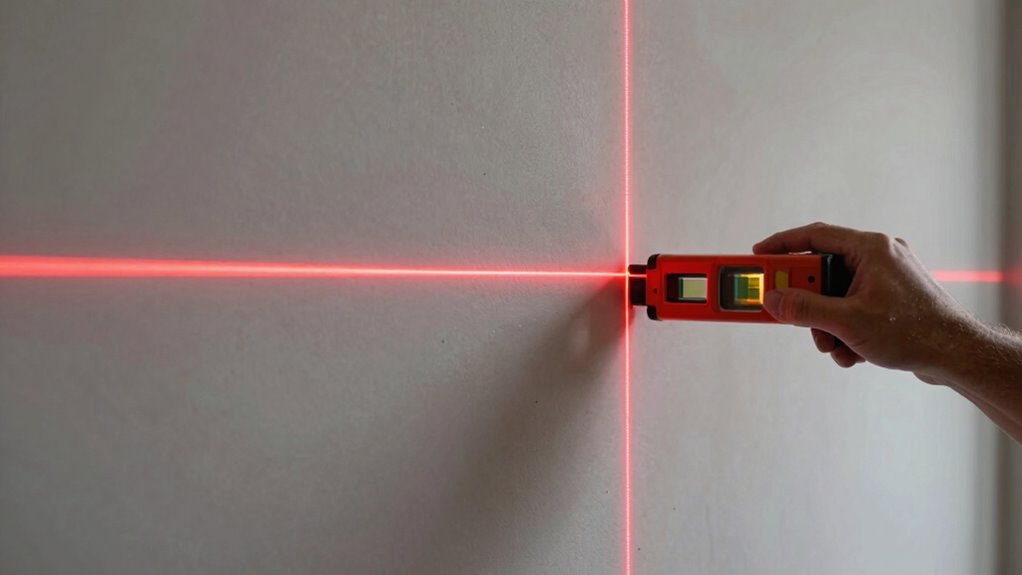

To get perfect lines without guessing, you need to properly mount your laser level on a stable surface like a tripod, wall bracket, or magnetic mount. This guarantees the laser remains secure, stable, and accurately aligned. Using features like self-leveling functions also helps keep lines straight, even on uneven surfaces. When your laser is correctly positioned and stabilized, you’ll achieve precise results every time. Keep exploring further to discover how to optimize your setup for flawless lines.
Key Takeaways
- Use a high-quality laser level with self-leveling features for accurate, straight lines automatically.
- Properly mount the laser level on a stable surface or tripod to prevent movement and ensure precision.
- Choose the right mounting option—tripod, magnetic, or wall mount—based on your project environment for optimal stability.
- Confirm the laser level is calibrated and level before starting to avoid measurement errors.
- Always verify laser lines visually and adjust for any discrepancies to maintain perfect alignment throughout your project.
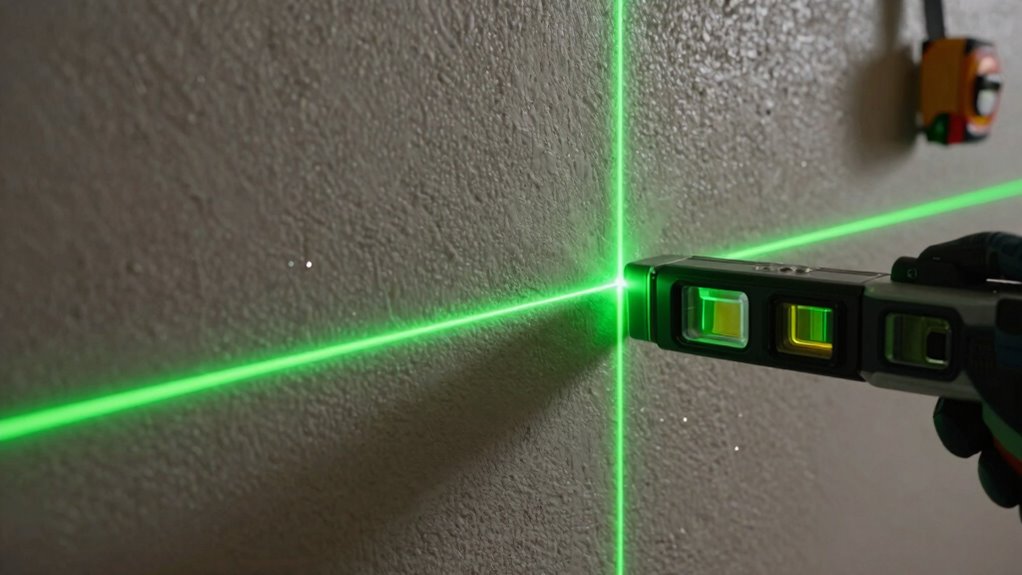
Have you ever wondered how professionals achieve perfectly straight lines in construction or decorating projects? The secret often lies in using a laser level, a tool that delivers precise, consistent lines to guide your work. One of the key aspects that make laser levels so effective is their versatile mounting options. Whether you’re attaching it to a tripod, using magnetic mounts, or fixing it directly to a wall, these options ensure the laser level stays secure and stable. Proper mounting is essential because even the slightest movement can throw off the laser’s accuracy, leading to crooked lines. So, you’ll want to select a mounting method that suits your project’s scale and environment. Tripods are excellent for flexibility, allowing you to adjust height and angle easily, while magnetic mounts work well on metal surfaces for quick setups. Wall mounts or brackets can keep your laser level fixed in a specific position for long-term projects. Additionally, understanding laser accuracy is crucial for ensuring your lines are perfectly straight over the desired distance.
Another critical factor that makes laser levels so reliable is their laser accuracy. Modern laser levels are designed to project lines with incredible precision, often within millimeters over long distances. This laser accuracy means you don’t have to guess or manually measure multiple times, saving you both time and effort. Plus, the laser beam is easy to see on most surfaces, providing a clear guide whether you’re installing tiles, framing walls, or aligning cabinetry. Some laser levels even come with self-leveling features, which automatically adjust the laser to a level position, ensuring your lines stay perfectly straight even if you set the device on uneven surfaces. This makes your work not only faster but also more accurate, reducing mistakes and rework.
Using these mounting options combined with the high laser accuracy of your device, you’ll find it’s much easier to achieve professional results. You won’t have to worry about manually marking lines or using traditional measuring tools that can be prone to errors. Instead, you can focus on your task, confident that your laser level will provide a reliable line every time. Whether you’re hanging pictures, installing shelves, or doing complex construction work, the right mounting options and laser accuracy make all the difference. They ensure your lines are straight, your measurements are precise, and your project turns out just as you envisioned. With a good understanding of these fundamentals, you’ll be able to use your laser level confidently and efficiently, making your work faster, cleaner, and more professional.
Frequently Asked Questions
How Do I Calibrate My Laser Level Accurately?
To calibrate your laser level accurately, start with calibration techniques like placing it on a flat, level surface or using a known level reference. Turn it on and check the laser beam against the reference points, adjusting as needed. Regular calibration improves accuracy, ensuring your lines are precise. By following these steps, you’ll maintain ideal performance and get perfect, straight lines every time.
Can Laser Levels Be Used Outdoors in Bright Sunlight?
Yes, you can use laser levels outdoors in bright sunlight, but outdoor lighting challenges can reduce laser level visibility. To improve visibility, choose a laser level with a brighter, more powerful beam or use a laser detector or receiver, which helps you see the laser line even in strong sunlight. Position yourself in shaded areas or use accessories like laser target plates for better accuracy and clearer lines.
What Are the Safety Precautions When Using Laser Levels?
Think of laser safety as your guiding star. Always wear eye protection to prevent potential damage from laser beams, and guarantee your workspace is secure to avoid accidents. Keep the laser level away from children’s reach and avoid pointing it at people or reflective surfaces. Before starting, check for proper calibration, and follow manufacturer instructions. Your awareness keeps your work safe and precise—don’t let safety slip through the cracks.
How Long Does a Typical Laser Level Battery Last?
A typical laser level battery lasts around 4 to 8 hours, depending on its battery type and power consumption. You can extend battery life by turning off the laser when not in use and avoiding high power settings. Keep spare batteries handy, especially for longer projects, to guarantee you don’t run out of power unexpectedly. Regularly check and recharge or replace batteries to maintain ideal laser performance.
Are There Specific Wall Types Suitable for Laser Level Use?
Imagine your laser level as a trusty steed, but not all walls are its ideal pasture. You’ll find that drywall, painted surfaces, and smooth concrete work best because of their surface adhesion qualities. Avoid textured or uneven wall materials like brick or rough plaster, as they can cause the laser to be misaligned or unclear. For the best results, choose surfaces that offer a flat, stable wall material.
Conclusion
Now that you know the basics of laser levels, you might wonder if they really are foolproof. The truth is, when used correctly, laser levels provide remarkably accurate lines, making your projects smoother and more precise. While some believe traditional tools are better, studies show laser levels consistently outperform manual methods in accuracy and efficiency. So, next time you’re planning a project, trust this modern tech—it’s proven to help you get perfect results every time.