
For most home cinema systems, I’d start with the Panamax MR4300: it pairs surge protection with power conditioning and is built for a multi-component setup. The Panamax MR4000 is a simpler home-theater-focused alternative, while the Amazon Basics 12-Outlet Surge Protector suits buyers who need plenty of outlets without dedicated conditioning features. The main tradeoffs are power-management features versus straightforward outlet capacity, along with cord reach, device spacing, and whether you need protection for coaxial or telephone lines. A strip with many outlets is not automatically the best match for an AV rack, where bulky plugs and connected signal lines can affect your layout. Read on for the full comparison and guidance on choosing for your system.

Get your wardrobe favorites delivered free with Prime
- Fast, free delivery on millions of items
- Prime Video, Amazon Music and more included
- Member-only deals all year
Key Takeaways
- Panamax’s MR4300, MR5100, and MR4000 lead the lineup for dedicated home cinema use because their power-management and conditioning focus is a closer match for multi-component systems than general-purpose strips.
- The MR4300 is the strongest all-around starting point; the MR5100 offers a more expansive power-management approach, while the MR4000 is a simpler option for buyers who do not need as many advanced features.
- Outlet count alone does not decide AV-rack fit. The 12-outlet Alestor and Amazon Basics models provide broad capacity, but buyers should check spacing and cord routing before connecting bulky adapters.
- Some picks protect more than AC power. The Panamax PM8-AV and Eaton Tripp Lite TLP118DBNET stand out for buyers who want to account for connected cable, satellite, telephone, or network lines.
- Compact and general-purpose strips serve different jobs from rack-style power management. Models like the ECHOGEAR, Belkin, Anker, and CyberPower strips may suit smaller or mixed-use setups, but they are not interchangeable with a dedicated cinema power conditioner.




| surge protectors for home cinema | Voltage | Surge protection | Maximum current | Dimensions |
|---|---|---|---|---|
| Nice Panamax MR4000 8-Outlet H | 120 volts | — | 15 A | 6 × 17 × 1.75 inches |
| Panamax M8-AV Hi-Definition 8 | — | — | — | — |
| Alestor 6 ft Surge Protector P | 125 volts | 2700 joules | 15 A | 11 × 3.9 inches |
| CyberPower CSB1206 Essential S | — | 3600 joules | — | — |
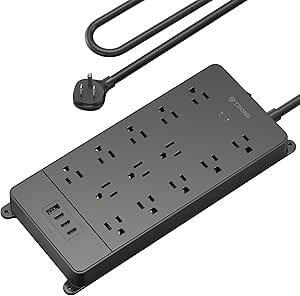
| TROND Surge Protector Power St | — | 4000 joules | 15 A | 10.87 × 4.64 inches |
| Amazon Basics 12-Outlet Surge | — | 4000 joules | — | — |
| Eaton Tripp Lite TLP118DBNET H | 120 volts | 4200 joules | 15 A | — |
| Panamax MR4300 Power Line Cond | 120 volts | — | 15 A | — |
| CyberPower HT812TC Home Theate | 120 volts | 4350 joules | — | — |
| Panamax PM8-AV 8 Outlet Cable | — | Yes | — | — |
| Panamax MR5100 11-Outlet Home | 120 V | — | 15 A | 17 × 12 in |
| Belkin 12-Outlet Surge Protect | 125 V | 3,940 joules | 15 A | 13 × 4.13 in |
| ECHOGEAR ShockBlocker 8 Outlet | 120 V | 3,420 joules | — | 11.75 × 3 in |
| Monster Pro MI Professional Su | 240 V | — | 8.17 A | 13.39 × 4.53 in |
| Anker Power Strip with 2100J S | 120 V | 2,100 joules | — | 13 × 4.17 in |
More Details on Our Top Picks
Nice Panamax MR4000 8-Outlet Home Theater Power Conditioner/Surge Protector
The MR4000 is the most cinema-focused choice here for buyers who want more than outlet-level surge protection. Its eight filtered outlets are paired with coax, LAN/Ethernet, and satellite line protection, covering signal cables that can also carry electrical surges into a system. Automatic voltage monitoring adds another layer for connected gear, while the rack-mountable, 1.75-inch-tall form fits a dedicated equipment stack. Compared with the Panamax M8-AV, it spells out LAN protection and Level 2 noise filtration, making it a stronger fit for a networked theater. The tradeoff is capacity: it is rated for 15 amps, and its 17-inch width calls for planned rack or shelf space. I would skip it if you mainly need an inexpensive outlet expander for a TV and a few accessories.
Pros:- Protects coax, LAN/Ethernet, and satellite lines as well as connected power equipment.
- Automatic voltage monitoring and Level 2 noise filtration are tailored to AV systems.
- Rack-mountable form suits an organized component stack.
- Eight outlets provide room for a receiver, display, source devices, and accessories.
Cons:- The 15-amp maximum current may limit some high-demand equipment combinations.
- Its 17-inch-wide chassis needs more dedicated space than a typical power strip.
- The product data does not specify a joule rating for direct comparison with several strips in this roundup.
Best for: Home theater owners with a rack or dedicated equipment shelf who need protection for power, coax, satellite, and Ethernet connections.
Not ideal for: Buyers with a cramped entertainment console or a high-power setup that may exceed its 15-amp rating.
- Outlets:8 filtered outlets
- Voltage:120 volts
- Maximum current:15 A
- Peak impulse current:52,000 A
- Signal-line protection:Coax, LAN/Ethernet, and satellite
- Additional protection:Automatic Voltage Monitoring (AVM); Level 2 noise filtration
- Dimensions:6 × 17 × 1.75 inches
- Weight:6.5 pounds
Our verdict“Choose the MR4000 for a rack-based cinema system needing signal-line protection, but not if compact size or a clearly stated joule rating is your priority.”
Panamax M8-AV Hi-Definition 8 Outlet Surge Protector
The M8-AV suits a home theater owner who values automatic voltage monitoring and protection for more than the AC plug. It has eight outlets, telephone and cable/satellite line protection, and power filtering intended to reduce electrical noise reaching audio and video components. Its automatic response to over- or undervoltage gives it a different emphasis from the CyberPower CSB1206: the CyberPower offers more outlets and a stated 3600-joule rating, while the M8-AV focuses on monitoring and AV signal connections. That makes this Panamax a better match for a modest component system with coax or telephone lines in use. The setup may feel more involved than a basic strip, and the bulky design can be awkward in a tight console. The supplied six-foot cord helps with placement, but there is no outlet count advantage over other eight-outlet theater models.
Pros:- Automatic voltage monitoring responds to over- and undervoltage conditions.
- Protects telephone and cable/satellite lines as well as AC-connected equipment.
- Power cleaning is aimed at reducing electrical noise in AV components.
- Six-foot cord and transformer spacing help with practical component placement.
Cons:- Eight outlets may be restrictive for a theater with many sources and accessories.
- Bulky construction can be difficult to fit behind a shallow console.
- Setup may be less straightforward than a conventional outlet strip.
Best for: Home cinema owners with a receiver, display, and cable or satellite connection who want voltage monitoring alongside power and signal-line protection.
Not ideal for: Buyers who need many widely spaced outlets, USB charging, or a compact strip with a published joule rating.
- Outlets:8
- Automatic Voltage Monitoring:Yes
- Telephone line protection:Yes
- Cable/satellite protection:Yes
- Power cord length:6 feet
- Transformer spacing:Yes
- AV compatibility:High-definition ready
Our verdict“Pick the M8-AV when voltage monitoring and coax or telephone protection matter more than extra outlets or USB charging.”
Alestor 6 ft Surge Protector Power Strip with 12 Outlets and 4 USB Ports
The Alestor is the flexible choice when a cinema area doubles as a charging station. Its 12 AC outlets and four USB ports can handle a TV, streaming box, console, controllers, and personal devices without adding a separate USB adapter. A stated 2700-joule rating and overload protection give it defined surge protection, while the six-foot cord offers some freedom to position it near a console. Compared with the TROND 4000J, the Alestor has one fewer AC outlet and a lower stated joule rating, but it still offers ample connections for a mixed-use room. Its USB-C inclusion is useful for charging newer devices, though the supplied data does not state individual USB output details. This is a power strip, not a signal-line protector or AV conditioner; buyers seeking coax protection or rack integration should choose a Panamax model instead.
Pros:- Twelve AC outlets and four USB ports reduce the need for separate chargers.
- The 2700-joule surge rating is stated in the product data.
- Six-foot cord allows useful flexibility around a TV stand or media desk.
- ETL certification provides a stated safety certification.
Cons:- No coax, LAN, or satellite signal-line protection is listed.
- The 2700-joule rating is lower than the TROND model’s stated 4000 joules.
- No individual outlet switches are listed for controlling components separately.
Best for: Families or console-room users who need many AC sockets plus USB charging for controllers, phones, and other personal devices.
Not ideal for: Dedicated theater owners who need coax, Ethernet, or satellite-line protection, or who want rack-mounted power conditioning.
- AC outlets:12
- USB ports:4, including USB-C
- Surge protection:2700 joules
- Voltage:125 volts
- Maximum current:15 A
- Cord length:6 feet
- Dimensions:11 × 3.9 inches
- Certification:ETL
Our verdict“Choose the Alestor for a shared media space that needs plentiful outlets and USB charging, not for a theater requiring signal-line protection.”
CyberPower CSB1206 Essential Surge Protector
The CSB1206 is a practical fit when a home theater has bulky power adapters that crowd a conventional strip. Its 12 outlets with wide spacing make it easier to connect a receiver, console, and larger plugs without sacrificing as many sockets. It also lists 3600 joules of surge protection and EMI/RFI noise filtration, giving it a more cinema-relevant feature set than a basic outlet expander. Compared with the USB-equipped Alestor, the CyberPower trades charging ports for a higher stated joule rating and wide-spaced outlets; the Alestor is more convenient for phones and controllers. The CSB1206 also includes a grounding indicator and wall-mountable design. Its limits are clear: the supplied details do not list coax or network-line protection, voltage monitoring, or USB ports, so it is best for straightforward AC-connected gear rather than a fully protected signal chain.
Pros:- Twelve outlets with wide spacing accommodate bulky power adapters.
- The stated 3600-joule rating exceeds the Alestor’s 2700-joule figure.
- EMI/RFI noise filtration is useful for an AV setup.
- Grounding indicator and wall-mountable design support flexible placement.
Cons:- No USB charging ports are listed.
- No coax, satellite, telephone, or Ethernet line protection is specified.
- It lacks the automatic voltage monitoring offered by the Panamax models in this batch.
Best for: Home theater owners with large adapters or multiple components who want ample AC outlets, noise filtration, and a stated surge rating.
Not ideal for: Buyers who need USB charging, automatic voltage monitoring, or protection for coax, satellite, and network lines.
- Outlets:12
- Surge protection:3600 joules
- Plug type:NEMA 5-15P right angle
- Cord length:6 feet
- Noise filtration:EMI/RFI
- Mounting:Wall-mountable
- Grounding indicator:LED grounding confirmation
- Connected equipment guarantee:$300,000
Our verdict“Choose the CSB1206 for a crowded component setup with bulky plugs, but look to Panamax if your theater needs signal-line or voltage-monitoring features.”
TROND Surge Protector Power Strip 5ft Cord, 4000J, 4 USB, ETL Listed, Black
For a media center with a long list of devices, the TROND offers the largest AC outlet count in this batch: 13 widely spaced outlets, plus four USB ports. Its stated 4000-joule rating is also higher than the Alestor’s 2700 joules and the CyberPower CSB1206’s 3600 joules, making it the strongest pick here by the published joule figure alone. The 14AWG, five-foot cord and flat plug can help keep a crowded entertainment area manageable, while wall mounting gives the strip a placement option beyond the floor. That flexibility comes with a compromise: unlike the Panamax MR4000, it does not list coax, Ethernet, or satellite-line protection, automatic voltage monitoring, or dedicated AV noise filtration. Its four USB ports provide a combined 17W, so I would treat them as convenient device-charging outlets rather than a replacement for faster dedicated chargers.
Pros:- Thirteen widely spaced AC outlets suit a large mix of AV and gaming equipment.
- The stated 4000-joule rating is the highest among the five products in this batch.
- Four USB ports add charging capacity without using AC sockets.
- Flat plug, five-foot cord, and wall-mountable design offer placement flexibility.
Cons:- No coax, Ethernet, or satellite-line protection is listed, unlike the Panamax MR4000.
- No automatic voltage monitoring or AV noise filtration is specified.
- The five-foot cord may be limiting when the wall outlet is far from the media area.
Best for: Owners of a densely equipped TV or gaming area who need many widely spaced AC outlets and occasional USB charging.
Not ideal for: Dedicated home cinema buyers who need signal-line protection, automatic voltage monitoring, or a longer cord for distant outlets.
- AC outlets:13
- USB ports:4
- USB output:17 W total
- Surge protection:4000 joules
- Maximum current:15 A
- Cord:5 feet; 14AWG; flat plug
- Dimensions:10.87 × 4.64 inches
- Mounting:Wall-mountable
- Material:Copper
Our verdict“Choose the TROND for outlet capacity and a high stated joule rating, but choose a Panamax conditioner if your theater needs broader AV-system protection.”
Amazon Basics 12-Outlet Surge Protector Power Strip, 4000 Joules, 8ft Extension Cord
For a home cinema with a TV, receiver, console, streaming box, and several accessories, the 12 outlets and 8-foot cord make this a practical, straightforward hub. Its 4000-joule rating is substantial for a standard strip, while the circuit breaker, safety shutters, and flame-retardant construction add useful protection features. Compared with the Eaton Tripp Lite TLP118DBNET, it gives you one more outlet but lacks that model’s coax, phone, and Ethernet protection—a meaningful difference if signal cables run into your equipment. It is also less specialized than the Panamax MR4300, which adds power conditioning and voltage monitoring. Choose this Amazon Basics option for plentiful AC connections and simple setup, not line-specific AV protection. Its indoor-only design, lack of USB ports, and no included wall mount limit installation flexibility.
Pros:- 12 outlets accommodate a large collection of cinema components
- 8-foot extension cord allows more flexibility in placing the strip
- 4000-joule surge rating is substantial for a basic power strip
- Circuit breaker, safety shutters, and flame-retardant material add safety features
Cons:- Does not protect coax, phone, or Ethernet connections
- No USB charging ports
- Wall mount is not included and use is limited to indoor spaces
Best for: Home cinema owners with many AC-powered devices who want a long cord and straightforward outlet capacity.
Not ideal for: Setups that need coax, phone, or Ethernet line protection, USB charging, or a wall-mount-ready installation.
- Number of outlets:12
- Surge protection:4000 joules
- Extension cord length:8 ft
- Circuit breaker:15 amp
- Material:PC flame-retardant
- Use:Indoor
Our verdict“Choose this for plentiful AC outlets and a long cord; pick the Eaton Tripp Lite instead if incoming signal lines also need protection.”
Eaton Tripp Lite TLP118DBNET Home Theater Surge Protector 11 Outlets
The TLP118DBNET earns its place for home cinemas where protection needs to cover more than power plugs. Alongside 11 outlets and a 4200-joule rating, it has Ethernet, phone, and coax connections, helping shield the paths that can otherwise bypass an AC-only protector. Side-facing outlets also make bulky adapters easier to arrange than they may be on a tightly packed strip. Compared with the Amazon Basics 12-outlet model, this Eaton gives up one AC outlet but adds those dedicated signal-line connections; the CyberPower HT812TC offers coax and phone protection too, though with fewer outlets. A resettable circuit breaker and grounding LEDs provide useful status and reset features. The tradeoff is a 120-volt, North American-oriented design, with no smart control or USB charging listed. Its braided 8-foot cord adds reach, but the unit is less suited to frequent portable use.
Pros:- Protects Ethernet, phone, and coax connections as well as AC-powered devices
- 11 outlets, including side-facing sockets for bulky transformers
- 4200-joule surge rating
- Resettable circuit breaker and grounding LEDs provide practical status and safety features
Cons:- 120-volt design may not suit international power systems
- No smart or remote-control features are listed
- Does not list USB charging ports
Best for: Home theater owners with cable, telephone, or Ethernet lines connected to equipment and several components to power.
Not ideal for: International users, buyers who need USB charging or smart controls, and anyone seeking a light travel strip.
- Number of outlets:11
- Surge protection:4200 joules
- Extension cord:8 ft braided
- Voltage:120 volts
- Maximum current:15 A
- Line protection:Ethernet, phone, and coax
- Item weight:2 pounds
- Color:Black
Our verdict“Pick the Eaton when protecting coax, phone, and Ethernet lines matters more than gaining the Amazon Basics model’s twelfth outlet.”
Panamax MR4300 Power Line Conditioner and Surge Protector
The MR4300 is the most AV-focused choice here for buyers who want more than a high joule figure. It pairs surge protection with Level 3 noise filtration and Automatic Voltage Monitoring, features aimed at filtering electrical noise and responding to voltage fluctuations for a connected cinema system. That makes it a different proposition from the Amazon Basics strip, which offers more outlets but a simpler protection package. Compared with the Panamax PM8-AV, the MR4300 has nine outlets rather than eight and adds the stated voltage-monitoring feature; the PM8-AV instead lists multiple coax and telephone connections. The MR4300’s rack-mountability suits a dedicated equipment cabinet, while its 6.5-pound weight and 120-volt compatibility narrow its fit. Its two USB ports are useful for small devices, but it is not the light, general-purpose option in this group.
Pros:- Level 3 noise filtration is aimed at reducing electrical noise for AV equipment
- Automatic Voltage Monitoring adds protection against voltage fluctuations
- Rack-mountable design suits a dedicated home theater equipment setup
- Includes two USB ports and nine AC outlets
Cons:- At 6.5 pounds, it is heavier than simpler strip-style options
- 120-volt compatibility limits its use with other power standards
- Fewer outlets than the 11- and 12-outlet options in this batch
Best for: Home theater owners building a dedicated equipment rack who want power conditioning and voltage monitoring alongside surge protection.
Not ideal for: Buyers who need many outlets, protection for coax or phone lines, a lightweight strip, or compatibility beyond 120 volts.
- Number of outlets:9
- Voltage:120 volts
- Maximum current:15 A
- USB ports:2
- Power conditioning:Level 3 noise filtration
- Voltage monitoring:Automatic Voltage Monitoring
- Mounting:Rack mountable
- Item weight:6.5 pounds
Our verdict“Choose the MR4300 for rack-based AV gear and power conditioning; the Eaton Tripp Lite is a better fit if signal-line protection is your priority.”
CyberPower HT812TC Home Theater Surge Protector with Dust Covers
The HT812TC is a strong fit when a cinema system needs a tidy, mountable protector rather than the largest outlet count. Its 4350-joule rating, automatic shutdown, and EMI/RFI noise filtering give it a substantial protection feature set, while coax and phone-line connections cover two signal paths beyond AC power. Wide-spaced outlets help accommodate larger plugs, and the mountable, impact-resistant casing can keep the unit positioned near a TV or equipment shelf. Compared with the Eaton Tripp Lite TLP118DBNET, it has fewer outlets and no listed Ethernet protection, but its automatic shutdown and stated noise filtering make it a compelling focused option. The Panamax MR4300 is better suited to rack-based systems seeking voltage monitoring and power conditioning. Here, the 6-foot cord and eight outlets set a clear limit on placement and expansion; North American plug compatibility also rules out many international setups.
Pros:- 4350-joule surge rating
- Automatic shutdown and EMI/RFI noise filtering are listed
- Coax and phone-line protection extend coverage beyond AC outlets
- Mountable, impact-resistant casing and wide-spaced outlets support flexible placement
Cons:- Eight outlets provide less capacity than the Eaton Tripp Lite or Amazon Basics models
- No Ethernet protection is listed
- 6-foot cord and North American plug type limit placement and regional compatibility
Best for: North American home theater owners who want a mountable protector with coax and phone-line connections, noise filtering, and automatic shutdown.
Not ideal for: Large systems needing more than eight outlets, Ethernet line protection, a longer cord, or international plug compatibility.
- Number of outlets:8
- Surge protection:4350 joules
- Voltage:120 volts
- Power cord length:6 ft
- Plug type:Type A, 2-pin North American
- Mountable:Yes
- Additional line protection:Coax and phone
- Additional features:EMI/RFI noise filter, LED indicators, automatic shutdown
Our verdict“Pick the CyberPower for a mountable eight-outlet system with automatic shutdown; choose the Eaton if you also need Ethernet protection and more sockets.”
Panamax PM8-AV 8 Outlet Cable Satellite Telephone Surge Protector
The PM8-AV is tailored to a home cinema that uses cable or satellite equipment and needs its incoming lines protected alongside its power connections. It provides four coax outlets and two telephone outlets, plus power filtering and Protect or Disconnect circuitry intended to safeguard connected equipment during severe surges. That makes it more specialized than the Amazon Basics 12-outlet strip, which offers greater AC capacity but no listed signal-line protection. Compared with the Eaton Tripp Lite TLP118DBNET, the Panamax lists more coax connections, while the Eaton adds Ethernet protection and has three more AC outlets. Transformer spacing helps fit bulky adapters, but eight outlets may feel restrictive in a system with several components. Its 6-foot cord and more involved connection setup also make placement and installation less simple than with a basic strip.
Pros:- Four coax and two telephone outlets cover multiple incoming signal lines
- Protect or Disconnect circuitry is designed to safeguard equipment during catastrophic surges
- Power filtering is intended for high-definition home theater systems
- Transformer spacing helps accommodate bulky plugs
Cons:- Eight outlets offer less AC capacity than the Eaton Tripp Lite and Amazon Basics models
- Ethernet protection is not listed
- Dedicated space and multiple line connections can make setup more involved
Best for: Cable or satellite home theater owners who want multiple coax connections, telephone-line protection, and surge protection in one unit.
Not ideal for: Buyers with many powered components, Ethernet protection needs, or a preference for a simple, minimal-setup power strip.
- Number of outlets:8
- Coax outlets:4
- Telephone outlets:2
- Surge protection:Yes
- Power cord length:6 ft
- Transformer spacing:Yes
- High-definition ready:Yes
- Warranty:3 years
Our verdict“Choose the PM8-AV for a cable or satellite system with several coax connections; choose the Eaton if you need Ethernet protection and more AC outlets.”
Panamax MR5100 11-Outlet Home Theater Power Management with Surge Protection and Power Conditioning
The MR5100 is the most system-focused choice here: its 11 protected outlets pair with power conditioning, voltage monitoring, and power sequencing. That combination suits a rack or entertainment center with a receiver, display, source components, and other gear, where managing startup and power conditions matters as much as adding outlets. Compared with the Belkin 12-Outlet strip, this Panamax offers more home-theater-specific management, while the Belkin provides a longer cord and a stated joule rating. The tradeoff is physical: at 13.5 pounds and 17 inches long, it needs a planned spot rather than a tight corner. Its listed specs also don’t include a joule figure, so buyers comparing protection by that number won’t have a direct figure here.
Pros:- 11 outlets support a multi-component theater setup.
- Power conditioning and noise filtration are aimed at sensitive AV equipment.
- Automatic voltage monitoring adds oversight beyond a basic outlet strip.
- Power sequencing helps manage how connected components start.
Cons:- Large, heavy chassis can be awkward to place in a compact media cabinet.
- No joule rating is provided in the supplied product data.
Best for: Home-cinema owners with several components who want power sequencing and voltage monitoring in a dedicated entertainment setup.
Not ideal for: Buyers seeking a slim, lightweight strip, a long flexible cord, or a published joule rating for direct spec comparisons.
- Outlets:11
- Voltage:120 V
- Maximum current:15 A
- Dimensions:17 × 12 in
- Weight:13.5 lb
- Power features:Surge protection, power conditioning, noise filtration, voltage monitoring, and power sequencing
Our verdict“Choose the MR5100 for a component-heavy cinema system that benefits from power management, not for a compact setup that mainly needs extra outlets.”
Belkin 12-Outlet Surge Protector Power Strip with 8ft Flat Plug
The Belkin makes a strong practical case for a cinema setup that needs many outlets and a clearly stated protection rating: it has 12 outlets and 3,940 joules of surge protection. Its 8-foot cord can reach a more convenient wall outlet, while spaced outlets help keep bulky adapters from crowding one another. Compared with the Panamax MR5100, it gives you one more outlet and a published joule figure, but lacks the MR5100’s power conditioning, voltage monitoring, and sequencing. The Belkin is a straightforward surge strip, not a component-management system. Its 13-inch body may still take up noticeable space behind a cabinet, and its stated 125 V, 15 A capacity makes it a North American-oriented fit rather than a universal option.
Pros:- 12 outlets accommodate a receiver, TV, streaming devices, and accessories.
- 3,940-joule rating provides a clear surge-protection specification.
- Eight-foot cord allows flexible placement away from the wall outlet.
- Widely spaced outlets and a safety indicator support practical setup and checking.
Cons:- Does not list power conditioning, voltage monitoring, or sequencing features like the Panamax MR5100.
- Its 13-inch body may be cumbersome in tight spaces.
- 125 V and 15 A specifications limit its fit for other electrical regions.
Best for: Home-cinema owners who need many outlets, a long reach to the wall, and a published surge-energy rating without dedicated power sequencing.
Not ideal for: Buyers wanting AV power conditioning or voltage monitoring, or those placing a strip in a very narrow media cabinet.
- Outlets:12
- Surge protection:3,940 joules
- Voltage:125 V
- Maximum current:15 A
- Cord length:8 ft / 2.4 m
- Dimensions:13 × 4.13 in
- Weight:2 lb
- Plug type:Type B, 3-pin
Our verdict“Pick the Belkin if outlet count, cord reach, and a published surge rating matter more than dedicated home-theater power management.”
ECHOGEAR ShockBlocker 8 Outlet Surge Protector Power Strip – Slim Design with 3420 Joules Protection
The ShockBlocker suits a wall-mounted TV or a shallow media area where a bulky strip would be hard to hide. Its low-profile, mountable design and 3,420-joule rating combine space-conscious placement with a stated level of surge protection. Eight outlets are enough for a modest TV-and-streaming setup, and the extra spacing can help larger plugs fit without blocking neighbors. Compared with the 12-outlet Belkin, the ECHOGEAR gives up outlet capacity and cord-length information in the supplied specs, but its slimmer format is the more natural match for a tight installation. Safety covers add protection for unused outlets. The listed enclosure material is paper, an unusual specification that raises a durability question; buyers who need a substantial metal or rack-style unit may prefer another option.
Pros:- Low-profile, mountable design can fit discreetly near a wall-mounted TV.
- 3,420-joule surge rating is specified.
- Extra outlet spacing helps accommodate larger plugs.
- Safety covers protect unused outlets from dust or accidental contact.
Cons:- Eight outlets offer less capacity than the Belkin and Anker 12-outlet options.
- Supplied product data lists the enclosure material as paper, which may concern buyers prioritizing durability.
- The supplied specs do not state cord length.
Best for: TV owners mounting a slim strip behind or near a display and connecting a small number of AV devices.
Not ideal for: Owners of large component systems who need more than eight outlets, or buyers who want a clearly specified durable enclosure.
- Outlets:8
- Surge protection:3,420 joules
- Voltage:120 V
- Dimensions:11.75 × 3 in
- Mountable:Yes
- Switch:On/off
- Plug type:Type A
- Compatible devices:AC devices and TVs
Our verdict“Choose the ShockBlocker for a compact, mountable TV setup; choose a higher-capacity strip for a full component stack.”
Monster Pro MI Professional Surge Protector Power Strip with Fireproof MOV Technology
The Monster Pro MI is a flexible choice when the theater’s wall outlet is far from the equipment: its 15-foot cord, mountable body, and eight grounded outlets make placement easier than with the Anker’s five-foot lead. A stainless-steel enclosure and fire-resistant MOV technology give it a more robust, safety-focused profile than a basic plastic strip. It also includes two USB ports and is described as reducing electrical interference, which may appeal to a mixed audio-and-computer setup. The tradeoff is a narrower fit than the Belkin or Anker for systems that need a dozen AC outlets. Its listed 240 V and 8.17 A specifications also deserve a careful compatibility check before connecting a home-cinema system; the supplied data does not give a joule rating.
Pros:- 15-foot cord supports placement far from the wall outlet.
- Stainless-steel enclosure and mountable design suit fixed installations.
- Fire-resistant MOV technology is a stated safety feature.
- Two USB ports add charging options alongside the AC outlets.
Cons:- Eight outlets provide less capacity than the Belkin or Anker 12-outlet strips.
- Listed 240 V and 8.17 A specifications may not suit every home-cinema system.
- The supplied product data does not state a joule rating.
Best for: AV owners who need a long cord, mountable metal enclosure, and a few USB charging ports near a theater setup.
Not ideal for: Buyers needing more than eight AC outlets, a stated joule rating, or a straightforward match for 120 V equipment without checking compatibility.
- Outlets:8 grounded
- USB ports:2
- Voltage:240 V
- Maximum current:8.17 A
- Cord length:15 ft
- Dimensions:13.39 × 4.53 in
- Weight:2.8 lb
- Enclosure material:Stainless steel
- Warranty:2 years
Our verdict“Consider the Monster Pro MI when cord reach and a metal mountable body are priorities, after confirming its electrical specifications match your equipment.”
Anker Power Strip with 2100J Surge Protector, Outlet Extender, 20W, 12 AC Outlets
The Anker is the most convenient pick here for a media area that doubles as a charging station. It combines 12 AC outlets with a 20 W USB-C port and two USB-A ports, so phones and small accessories needn’t occupy the outlets intended for cinema gear. Its 2,100-joule rating is clearly stated, though it is lower than the Belkin’s 3,940 joules. The Anker also has a shorter five-foot cord than the Belkin’s eight-foot lead, making it a better fit when the strip sits near the wall outlet. Compared with the Panamax MR5100, it offers more convenient everyday charging but none of the described power sequencing or conditioning. Shared USB output and the lack of advanced charging features limit its appeal for demanding charging needs.
Pros:- 12 AC outlets support a crowded TV and media setup.
- USB-C and two USB-A ports keep small-device charging off the AC outlets.
- 2,100-joule surge rating is specified.
- Layout is designed to accommodate bulky plugs.
Cons:- Its 2,100-joule rating is below the Belkin’s stated 3,940 joules.
- Five-foot cord may not reach a convenient wall outlet.
- USB power is limited or shared across ports, with no advanced charging features listed.
Best for: Home-cinema households that want a dozen AC outlets plus USB-C and USB-A charging for phones and small devices nearby.
Not ideal for: Buyers prioritizing a higher stated joule rating, a long cord, advanced AV power management, or fast charging across several USB devices.
- AC outlets:12
- Surge protection:2,100 joules
- Voltage:120 V
- USB ports:3 total: 1 USB-C and 2 USB-A
- USB-C output:20 W
- Cord length:5 ft
- Dimensions:13 × 4.17 in
- Weight:1.3 lb
- Warranty:18 months
Our verdict“Choose the Anker for a nearby media-and-device charging hub, but opt for the Belkin for a higher stated joule rating or the Panamax for AV power management.”

How We Picked
I ranked these surge protectors for home cinema by how well their stated features suit a TV, receiver, streaming device, game console, and other AV components used together. I compared their focus on surge protection and power management, outlet capacity, form factor, cord reach, and any provision for coaxial, telephone, or network connections. I also weighed practical usability: a high outlet count is less helpful if the unit is awkward to place or crowded by large plugs.
The ranking favors products with a clear home-theater role and useful system-level features over strips that mainly add outlets or USB charging. Panamax models rank highly for dedicated AV power management, with their relative positions reflecting feature scope and likely fit for different systems. General-purpose strips remain worthwhile when outlet access, cord length, or compactness matters more than specialized conditioning; their lower placement reflects that narrower home-cinema role, not a claim that they cannot power AV equipment.
Factors to Consider When Choosing Surge Protectors For Home Cinema
Choosing a cinema power unit is less about chasing the biggest number on the box and more about matching the device to your equipment, wiring, and room layout. I’d settle those basics before deciding whether a dedicated conditioner or a simpler strip makes sense.
Count Devices, Then Plan for Plug Size
Make a list of every device that will share the unit, including a receiver, television, console, streamer, subwoofer, and any chargers. Add a little spare capacity so a future component does not force a second strip or a crowded outlet arrangement. Physical spacing matters as much as outlet count: large power bricks can block neighboring sockets even on a unit with many outlets. Check whether the design places outlets along one face or spreads them around the body, and compare that layout with your components’ plugs. A 12-outlet strip may suit a flexible room setup, while a rack-oriented unit can be easier to organize with fixed AV gear. Avoid daisy-chaining strips to solve a capacity problem; choose one properly rated unit with enough usable outlets instead.
Separate Surge Protection From Power Conditioning
Surge protection and power conditioning are related but different claims, so decide which job you actually need. A basic protector is designed to help guard connected equipment from voltage surges; a conditioner may add power-management features intended for an AV system. Do not assume conditioning will improve picture or sound on every setup, or that a product labeled for home theater offers every feature found in a higher-tier model. Compare the manufacturer’s stated functions and connection guidance rather than relying on broad claims. For a modest TV-and-streamer setup, straightforward surge protection may be enough. Buyers with several costly components may prefer a dedicated unit with clearer system-level management, provided its added features fit their needs.
Protect Signal Lines That Enter the Room
Power is not the only route a surge can take into a system. Cable, satellite, telephone, or network wiring can connect equipment to lines that enter from elsewhere in the home. Check every incoming connection path and confirm that the protector supports the specific line type you use; an AC-only unit will not cover a coaxial cable connected separately to a television or receiver. Do not buy line protection just because it is present if your setup has no matching connection. Follow the manufacturer’s instructions for connecting and grounding those lines, since correct installation affects how the protection works. This factor can make a model with fewer AC outlets a better fit for a system that relies on cable or satellite service.
Match the Form Factor and Cord to the Room
Measure the distance from the equipment to the wall outlet before choosing a cord length, and check whether the plug can sit behind furniture without bending sharply. A flat plug can help in tight spaces, while a slim strip may fit better beside a cabinet than a larger power-management unit. For an AV rack, consider mounting position, access to controls, and whether the cables can leave the unit without crossing ventilation openings. Keep power equipment accessible rather than burying it under furniture or stacking it beneath warm components. A longer cord can solve reach issues, but it should not be routed where it can be pinched or become a trip hazard. Choose the shape around the room’s actual layout, not just the product photo.
Read Protection and Safety Details Carefully
Compare the manufacturer’s stated surge-protection specifications, safety listing, and instructions for the exact model. A joule figure can help distinguish products, but it is not a complete measure of suitability and should not replace checking the rest of the design. Confirm that the unit is intended for your local electrical system and that its load limits match the equipment you plan to connect. Look for guidance on indicator lights, replacement, and what happens when the protective components reach their service limit. Do not connect equipment with a demand beyond the protector’s rating, and avoid using a damaged cord or unit. These checks are more useful than treating one specification as a guarantee of long-term protection.
Decide When a Premium AV Unit Is Worth It
A dedicated power-management unit makes the most sense when its added functions solve a real problem: organizing several components, managing power, or protecting connected signal lines. If your needs are limited to a television and one or two small devices, a simpler protector may avoid paying for features you will not use. Spend for capability, not just the premium label; compare the features you will use against the physical size and setup demands. Also check the manufacturer’s terms for connected-equipment coverage and warranty, since conditions and exclusions vary. Buyers planning a larger rack should consider how the system may grow, while a compact living-room setup can prioritize easy placement and enough well-spaced outlets. The right tier depends on equipment count and installation, not the size of the screen alone.
Frequently Asked Questions
Is a power conditioner necessary for a TV and soundbar?
Usually, the first question is whether you need a dedicated conditioner or simply a suitable surge protector with enough outlets. A TV-and-soundbar setup has fewer components to manage than a full AV rack, so a general-purpose protector may meet the practical need. Choose a conditioner when its stated power-management features address something specific in your system, rather than assuming it will improve everyday picture or audio quality. Check the device ratings and connection instructions before plugging everything in. If you plan to add a receiver, game console, or other equipment, allow for those devices when choosing outlet capacity.
Should I choose the Panamax MR4300 or MR5100 for a growing system?
Start by comparing the functions, connections, and outlet arrangement listed for the exact models, then match those details to your equipment plan. The MR5100 sits higher in this roundup for buyers seeking a broader power-management feature set, while the MR4300 is the stronger all-around pick for many home cinema setups. A larger system does not automatically require the higher-ranked model if you will not use its added capabilities. List current and planned components, including any cable or network connections that need protection. Choose the model whose features fit that list without forcing an awkward installation.
Can I plug my receiver, TV, and subwoofer into the same protector?
That can be appropriate when the protector’s rating and the equipment manufacturers’ instructions allow it. Check the combined electrical demand rather than choosing by outlet count alone, and pay special attention to devices with higher power requirements. Do not exceed the unit’s load rating or chain multiple protectors to create extra capacity. A receiver and subwoofer may also need more outlet spacing than small streaming devices, so inspect the layout before buying. If you are unsure about the system’s load or wiring, consult a qualified electrician.
Do I need coaxial or network-line protection for my home cinema?
You may want it when a cable, satellite, or other supported signal line enters the room and connects directly to the AV equipment. An AC surge protector alone does not protect a separate coaxial or network cable. The Panamax PM8-AV and Eaton Tripp Lite TLP118DBNET are relevant choices in this roundup for buyers comparing extra line connections, but verify that each model supports the exact line you use. Follow the product’s installation and grounding instructions. If your setup has no such incoming connection, those extra ports may not be useful to you.
When is a general-purpose power strip a better choice than a home-theater unit?
A general-purpose strip can be the better fit when your main needs are accessible outlets, a suitable cord, or USB charging, and you do not need dedicated AV power-management features. Models such as the Amazon Basics, Alestor, and Belkin strips emphasize outlet capacity or placement flexibility rather than the same cinema-focused role as the Panamax conditioners. Check plug spacing, cord reach, safety information, and load limits before using one with AV equipment. Do not treat USB ports as a substitute for checking whether all your components have compatible power connections. For a multi-component rack, specialized features may justify choosing a dedicated home-theater model instead.
Conclusion
For the best overall, I’d choose the Panamax MR4300 for its dedicated home-cinema focus and power-management features. The best premium fit is the Panamax MR5100 for buyers who want a broader feature set for a larger system; the MR4000 is a more straightforward Panamax alternative. For best value and outlet capacity, compare the Amazon Basics 12-Outlet strip with the Alestor, using cord reach and plug layout to decide. Beginners with a small setup can start with a simple, clearly rated protector such as the CyberPower CSB1206 rather than paying for features they may not use. If you need protection for signal lines, compare the PM8-AV and Eaton Tripp Lite TLP118DBNET; for a compact or mixed-use space, consider the ECHOGEAR, Belkin, Anker, TROND, CyberPower HT812TC, or Monster options based on fit and stated features. My final choice would follow the equipment list and room layout first, then the extra features.